
Franklin County Arrest Records and Charges
Franklin County arrest records start with law enforcement and custody. The Franklin County Sheriff is the local office tied to jail, booking, arrests, bonds, and Security Center records. A jail or booking entry may show that a person was taken into custody, but it does not prove that the prosecutor filed every listed arrest allegation in court. Booking terms can also differ from the exact charge wording later entered in the Franklin Circuit Court case.
The court charge record starts when the Franklin County Prosecutor files a criminal case or charge with the court. MyCase then becomes the public court index for non-confidential cases using Odyssey. For full custody and jail-roster detail, use the Franklin County inmate records workflow. For pleas, trial settings, sentencing, and final outcome, use the full Franklin County criminal court records case file.
This distinction is important after a same-day arrest. A person may appear in custody before the prosecutor files final court charges, or the prosecutor may file charges that differ from the first booking description. Franklin County charge research should therefore compare three channels: sheriff or jail custody data for arrest status, MyCase for filed court charges, and the Clerk of the Circuit Court for public documents that are not linked online.
The county sheriff department page is the source for local arrest and jail contact routing. The image below comes from the Franklin County sheriff department page.
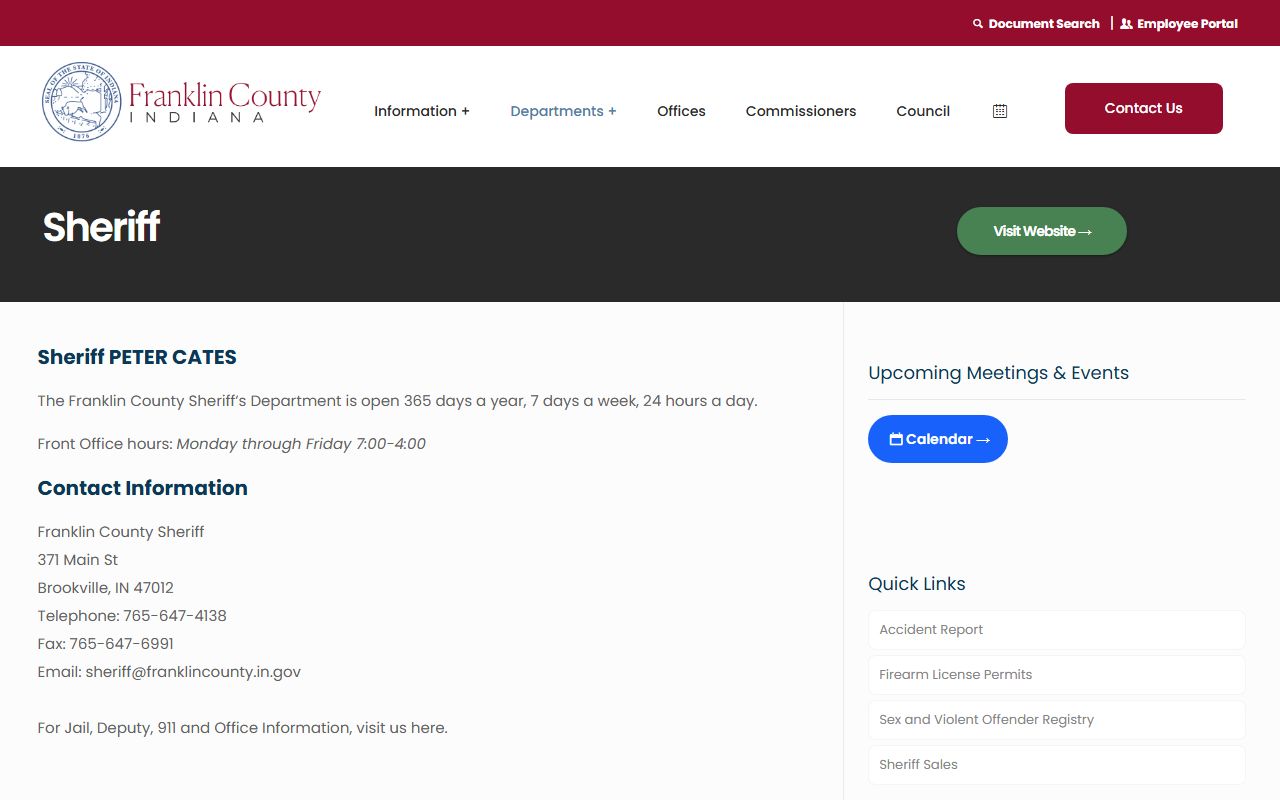
That sheriff source is useful for the arrest side, while the court charge side is checked through the court and clerk channels.
Search Franklin County Arrest Records
For charges after arrest, start with Indiana MyCase. Search by defendant name or case number, then narrow to Franklin County when the interface allows it. Open the case detail and read the chronological case summary for charge filings, probable-cause entries, initial hearing events, bond settings, warrants, plea entries, dismissal events, and sentencing entries. If the document itself is not linked, Indiana courts direct users to the county clerk where the case is heard.
- Open MyCase or the Indiana Judicial Branch Franklin County Courts page and use the case-search link.
- Search by case number when known. Use defendant name if the case number is not available.
- Open the Franklin County result that matches the filing date, court, and party name.
- Read the charge list for statute, level, filing date, and current status.
- Call the Clerk of the Circuit Court if a public document is not linked online.
Indiana courts state that MyCase is not a full criminal-history search. Statewide criminal-history checks route to the Indiana State Police Limited Criminal History service, which has its own search limits and fees. For sentenced state-prison custody, use the Indiana Department of Correction offender locator instead of treating a county charge record as a custody record.
Use the case number when possible because Indiana names can produce statewide results from multiple counties. If the arrest began with a local police agency, also note the agency and approximate arrest date. Those details help separate a Franklin County Circuit Court charge from a Batesville, Brookville, or out-of-county matter. If MyCase shows a charge but no document link, the docket still helps identify what to ask the clerk to copy.
Indiana public-defense resources can help explain court process and indigent-defense standards. The image below comes from the Indiana Public Defender Commission links page.
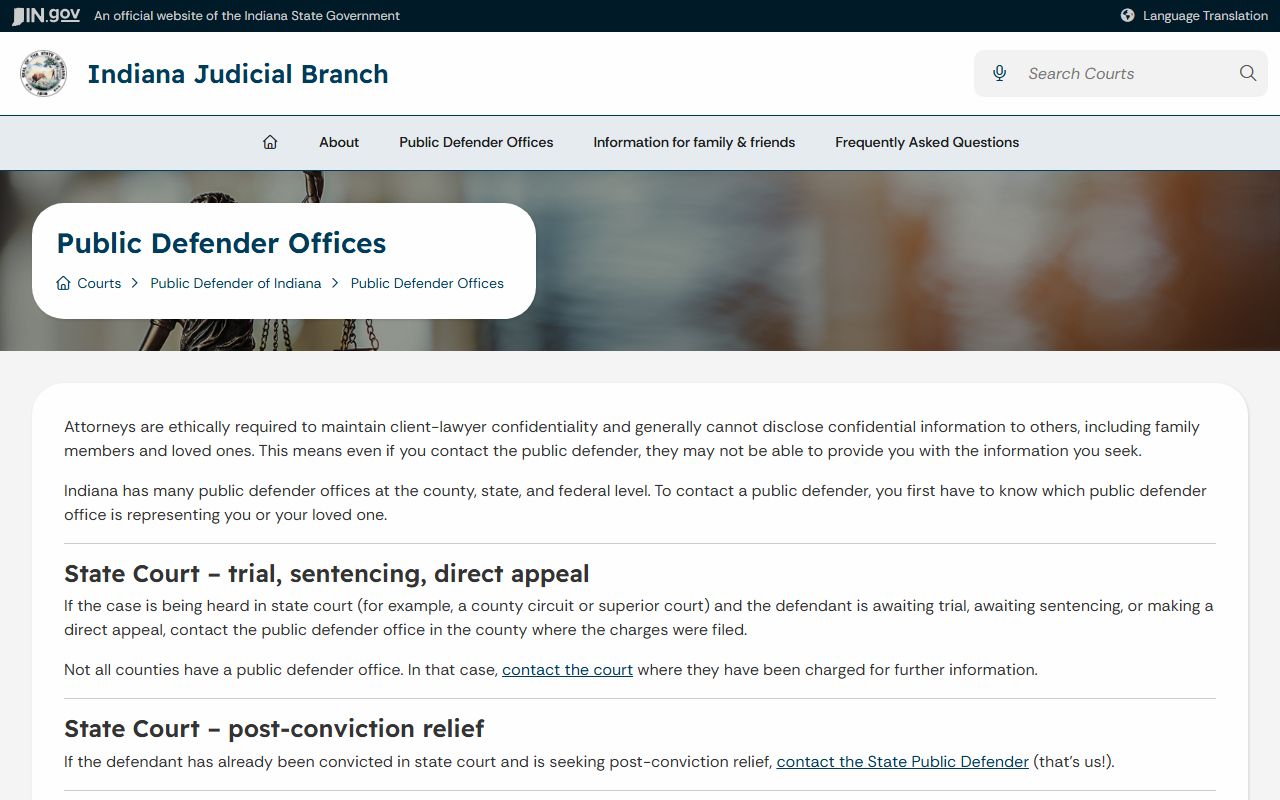
That source supports the practical point that a charge record is a court matter, and legal help may be needed when charges are pending.
Franklin County Charging Documents
Indiana counties use prosecuting attorneys, not district attorneys. For Franklin County, the Franklin County Prosecutor decides which charges to file after reviewing law-enforcement reports and probable cause. The charging information becomes more important than the booking label because it is the court accusation that drives hearings, bond, plea talks, dismissal, conviction, or sentence.
| Document | Who Files It | What It Does |
|---|---|---|
| Complaint | Law enforcement or prosecutor, depending on the matter | Starts or supports the accusation and probable-cause review. |
| Information | Prosecutor | Lists formal criminal charges filed by the State of Indiana. |
| Indictment | Grand jury process | Charges a case through grand-jury action when that route is used. |
The prosecutor page is the county source for the charging office, victim assistance, child support division, and drug-tip hotline. The image below comes from the Franklin County Prosecutor page.
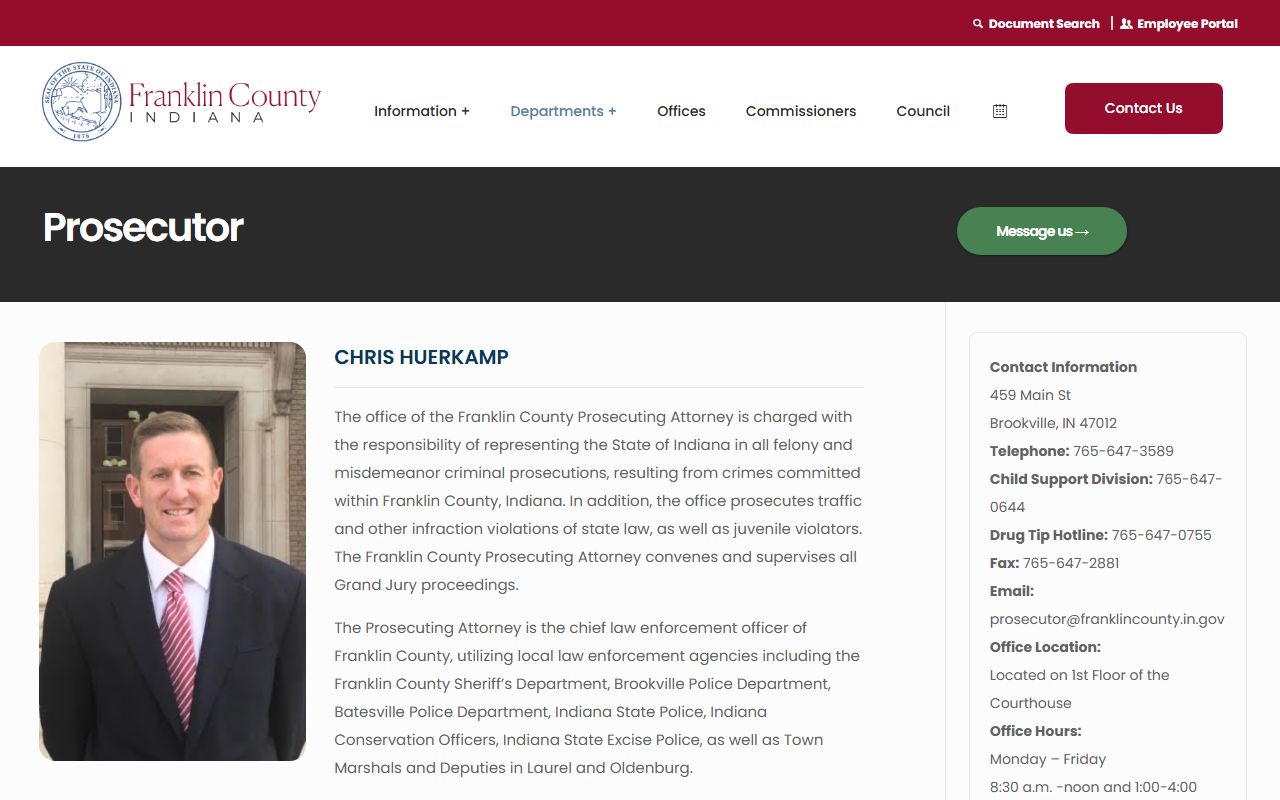
That office is relevant to filed charges, but it is not the clerk counter for public copies or certified court documents.
Franklin County Charge Status
Charge status can change as the case moves. One arrest may lead to several filed charges, and later entries may show amendment, reduction, dismissal, or conviction on only some counts. MyCase docket events and the charge list should be read together because the status line may not tell the whole story without the chronological case summary.
Franklin County bond and warrant events should be read as part of the case timeline, not as a final charge outcome. A bond entry can show conditions for release, while a warrant entry can show missed court or arrest authority. Neither one proves conviction. The disposition and sentencing entries, when present, are the strongest public indicators of how a filed charge was resolved.
| Status | What It Means | Where to Verify |
|---|---|---|
| Pending | The accusation is still open and has not reached final disposition. | MyCase case status and next hearing entries. |
| Amended or reduced | The filed charge changed in wording, level, or count number. | Docket entries, orders, and charge detail. |
| Dismissed | The court ended that charge or count without conviction. | Disposition entries and court orders. |
| Warrant or bond event | The case includes custody, appearance, or security-for-appearance activity. | Chronological case summary and sheriff bond information. |
The Franklin County sheriff bond page explains local bond schedule notes, including cash/surety handling for Level 3 and Level 4 felonies and cash-only bonds for other bondable offenses. The image below comes from the Franklin County arrests and bonds page.
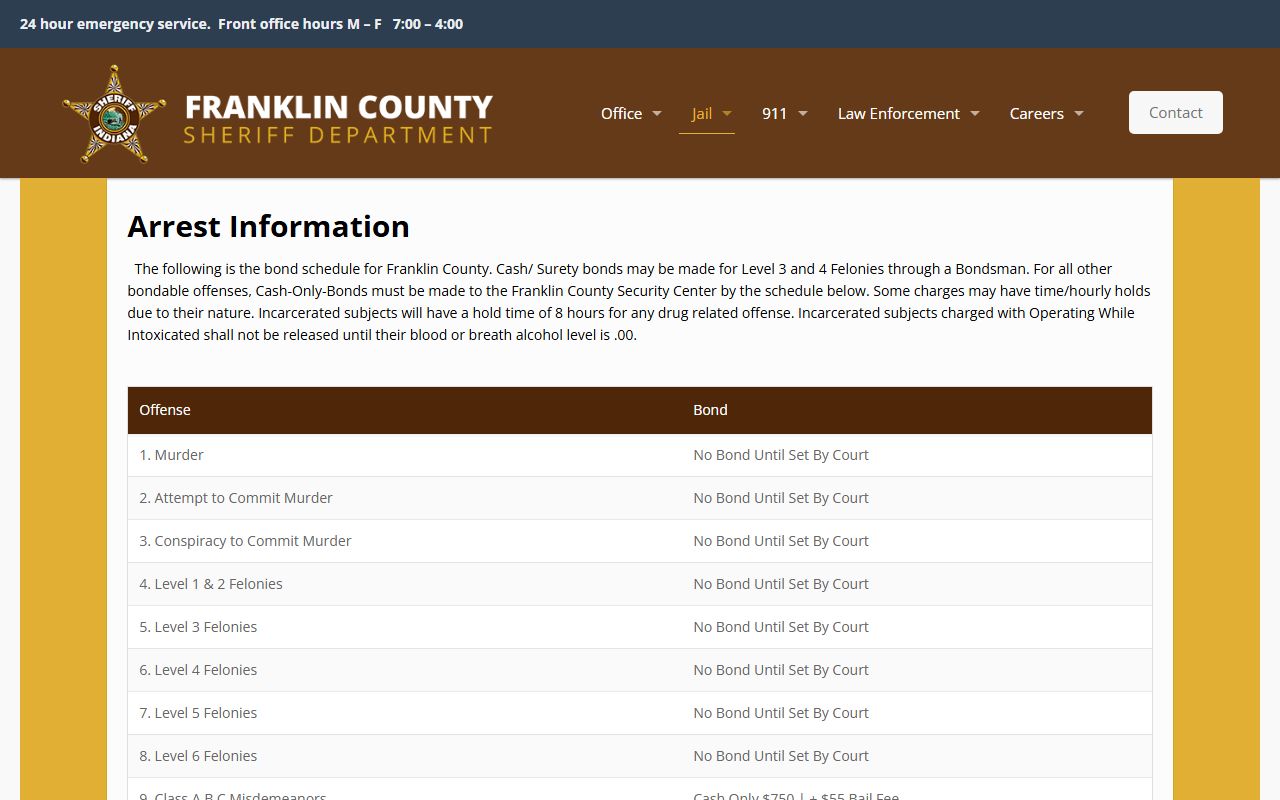
Bond rules help explain custody after arrest, but the filed charge and final status still come from the court record.
Franklin County Charges vs Convictions
A charge is an accusation. A conviction is a final outcome after a guilty plea, verdict, or other qualifying court disposition. Franklin County court charge records may show charges that were later dismissed, reduced, or resolved in a way that does not match the original arrest label. That is why a reader should not treat a filed charge as proof of guilt.
| Point | Charge | Conviction |
|---|---|---|
| Meaning | Formal accusation filed in court. | Final finding or plea that establishes guilt. |
| Timing | Appears near case opening or amendment. | Appears at disposition or sentencing. |
| Record risk | May remain visible unless restricted or expunged. | May affect fines, sentence, probation, BMV, or criminal history. |
| Best source | Charge list and docket events in MyCase. | Disposition, sentencing order, and clerk copies. |
Statewide Charge and Custody Checks
Franklin County charge records can overlap with jail, SAVIN, IDOC, and state criminal-history systems, but those systems answer different questions. Jail and SAVIN show custody status. IDOC shows state-prison custody. Indiana State Police criminal-history services search a state criminal-history file, not the Franklin Circuit Court docket. When the question is whether a charge was filed in Franklin County court, MyCase and the Clerk of the Circuit Court remain the local court-record path.
Indiana State Police limited criminal-history results also have participation and data-scope limits noted in state materials. They are useful for a statewide criminal-history request, but they do not replace reading the Franklin County court docket for charge amendments, dismissals, pleas, or sentencing. The local court record is the better source for the path from arrest allegation to filed charge and final court action.
Some arrest-related questions concern inmate medical, jail holds, or custody rules rather than the court charge. The image below comes from the Franklin County inmate medical page.
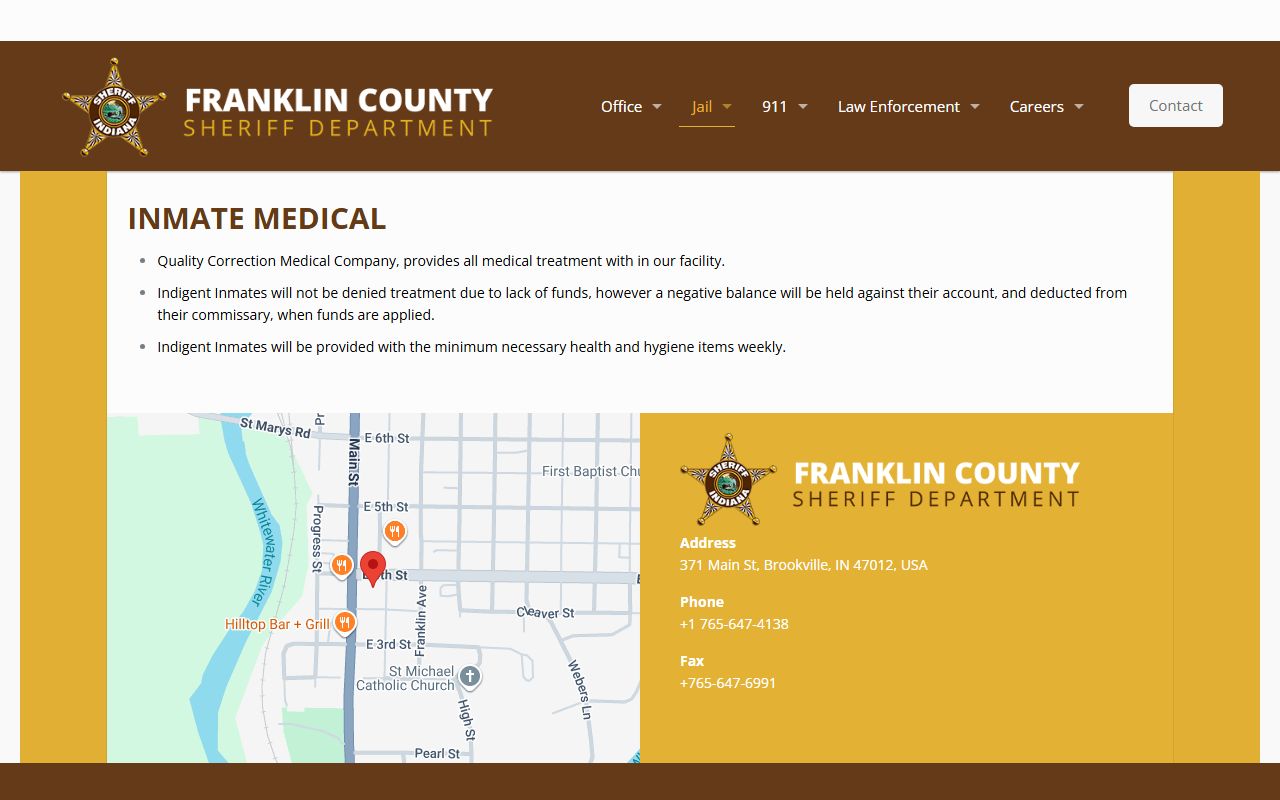
That custody context should not be read as a court disposition, because court outcomes are recorded through the case file.
For post-sentence state custody, the image below comes from the Indiana DOC offender locator information page.
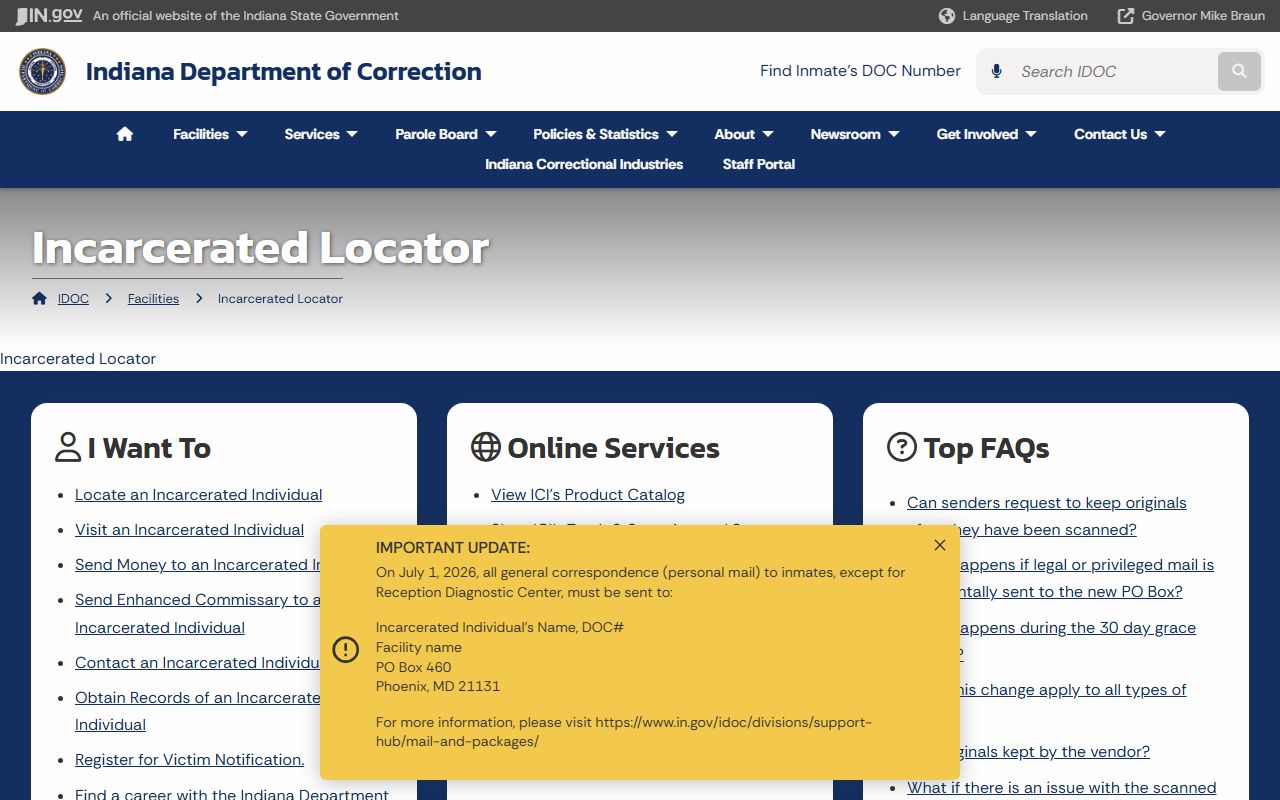
IDOC lookup helps after a person enters state custody; it does not replace Franklin County court charge lookup for local filed charges.
Restricted Franklin County Charge Records
Indiana public access rules make many court records public, but not all charge-related records appear online. Juvenile delinquency and CHINS matters are generally restricted. Protection-order protected-person details are excluded from online public access. Sealed and expunged cases are excluded from public search. Personal identifiers, financial account numbers, confidential addresses, and minor data are redacted or withheld.
Adult criminal expungement is governed by IC 35-38-9. Indiana juvenile confidentiality and expungement rules route through Indiana Code Title 31. Practical first stops in Franklin County are MyCase to see what remains public and the Clerk of the Circuit Court for filing or copy questions.
When a charge record is sealed, expunged, or juvenile-confidential, a public user may see no result or only a limited public event. Party access, attorney access, agency access, or a court order may be required. Franklin County users should not assume that a missing online record means no arrest ever occurred or that an online charge entry means the person was convicted. The source and status both matter.
Important: A dismissed charge may still need a court expungement process before it disappears from public search.